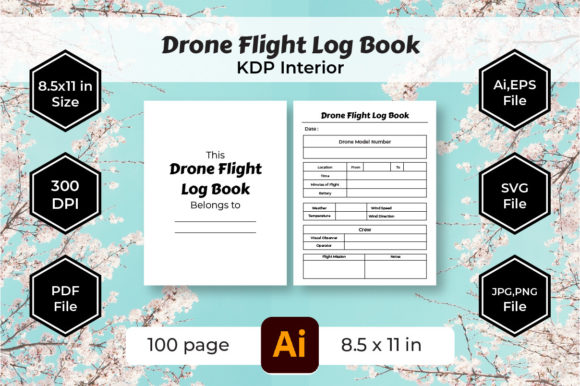
Drone Flight Log Book KDP Interior
A Designer’s First Glance: Clean, Niche, and Ready for Stitching
When I opened the Drone Flight Log Book KDP Interior, my first thought wasn’t “cute” or “trendy”—it was “functional with personality.” The layout feels purpose-built: structured yet approachable, technical without being cold. It leans into aviation minimalism—clean lines, subtle grid elements, and a restrained typographic rhythm. There’s no cluttered iconography or overwrought decoration. That’s a win. For embroidery designers, that means fewer tiny details to fight with on fabric—and more breathing room for clean satin stitches and legible fill areas.
Real-World Test: Embroidering This Design on a Custom Tote Bag
Last week, I prepped a linen-cotton blend tote for a local drone enthusiast’s small business launch. I chose the Drone Flight Log Book KDP Interior as the centerpiece—not as a standalone graphic, but as a stitched title block above a simple flight date field. On the hoop, it held up beautifully: crisp corners, balanced negative space, and letterforms that translated well into running and satin stitch without distortion. Customers noticed it immediately—not just because it looked professional, but because it *felt* intentional. That quiet confidence matters when you’re selling handmade products at craft fairs or listing on Etsy.
Where It Shines (and Where It Needs Caution)
The Drone Flight Log Book KDP Interior works exceptionally well for:
- Custom apparel—especially sweatshirts and structured caps where clean typography reads clearly at medium scale;
- Embroidered patches—its vector foundation (EPS, SVG, AI) makes resizing predictable, and its moderate detail level avoids thread piling in tight corners;
- Baby embroidery—think onesies or burp cloths—when simplified to a single-line logbook icon or monogrammed header, it adds gentle thematic charm without overwhelming delicate fabric;
- Holiday or wedding gifts—a pilot couple’s anniversary, a graduation gift for an aviation student—where personalization meets quiet sophistication;
- Small shop merchandise—used as a branded interior page graphic for printed logbooks *and* as a stitched accent on matching aprons or tea towels in a boutique kitchen line.
But here’s where attention matters:
- Small hoop sizes: The full layout may need trimming or repositioning for hoops under 4×4". Prioritize the logbook title or flight date section instead of scaling down everything.
- Textured or stretchy fabric: On terry cloth towels or lightweight knits, test stabilizer choice first—medium-weight cutaway helps maintain shape without adding bulk.
- Dark or layered garments: If stitching onto navy sweatshirts or quilted jackets, verify thread color contrast early. A charcoal gray fill stitch can disappear on black fabric unless paired with a bright outline.
- Tiny lettering: Some interior labels or fine grid lines may fall below 6pt equivalent in stitch height—check those in your embroidery software before finalizing.
How It Elevates Your Finished Product
This isn’t just another machine embroidery design. It carries tone. When stitched onto a canvas tote, it signals craftsmanship—not just “I made this,” but “I understood what this customer values: precision, memory-keeping, and quiet pride in their craft.” That perception lifts perceived value. Buyers trust handmade products that look cohesive and considered—and the Drone Flight Log Book KDP Interior supports that instinct. It also reinforces brand consistency for creative entrepreneurs building around niche themes like aviation, engineering, or outdoor tech.
For Etsy sellers and small shop owners, it’s a rare asset: a digital embroidery file that doubles as a printable mockup element. Use the SVG version to build lifestyle shots—show the design stitched on a cap, then mirrored as a clean graphic overlay on a digital logbook cover. That cross-format flexibility is gold for product listings.
Practical Designer Notes Before You Stitch
Before committing to your first run:
- Test on scrap fabric first—especially if using textured weaves or blends. Watch how fill stitch settles into the grain.
- Review stitch density in your embroidery software. Dense fills may shift on lightweight fabrics; consider reducing density by 5–10% for baby items or delicate linens.
- Confirm hoop size compatibility. Since no exact dimensions are provided with the Drone Flight Log Book KDP Interior, measure the vector art in Illustrator or Inkscape before digitizing.
- Inspect small details at 200% zoom—look for hairline gaps, overlapping paths, or stray anchor points that could cause skipped stitches.
- Test black-and-white mockups to assess contrast and hierarchy without color distraction.
- Compare light vs. dark fabric backgrounds—some thin strokes or light grays may vanish on black unless adjusted.
- Use proper stabilizer: tear-away for stable wovens, cutaway for knits or stretchy synthetics.
- Verify licensing for commercial use—since this is labeled Kdp Interiors and Graphics, confirm whether finished embroidered items or derivative digital products (like custom logbook templates) are permitted under the license.
Final Thought: A Quietly Confident Design Asset
The Drone Flight Log Book KDP Interior doesn’t shout. It observes, organizes, and anchors. That makes it unusually versatile—not just for drone pilots, but for any maker who values clarity, narrative, and thoughtful execution. Whether you’re embroidering a personalized gift, building a craft business around technical hobbies, or sourcing reliable design assets for client work, this file earns its place in your working library. Just remember: respect the fabric, honor the detail, and let the design do what it does best—support the story, not steal it.